


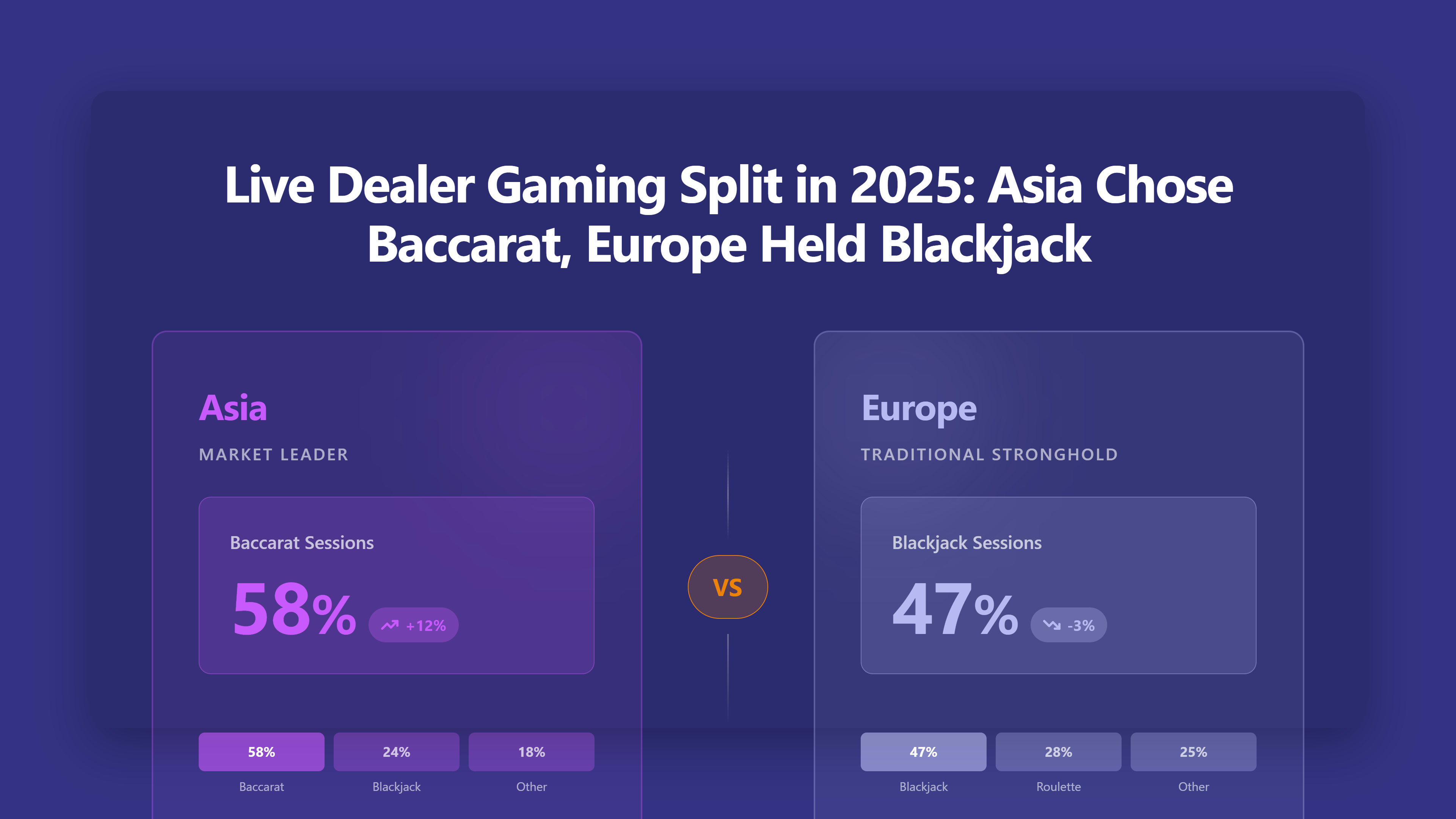
Live Dealer Gaming Split in 2025: Asia Chose Baccarat, Europe Held Blackjack

Recommended casinos
Two continents. Two completely different live dealer strategies. Both worked.
We spent 2025 tracking live dealer adoption patterns across Asia-Pacific and Europe, and what we found was not a temporary split. Asia-Pacific went all-in on baccarat hybrids and recorded a 27% jump in adoption over six months. Europe stayed committed to blackjack, localized the experience country by country, and watched live dealer titles climb to 68% of the top-ranked games by year-end.
What the Numbers Actually Show
Between April and September 2025, Southeast Asia saw live dealer adoption increase by 27%. Across the broader Asia-Pacific region, live engagement climbed 28% in the same period. When we looked at supplier commentary and studio launch decisions, the driver was clear: baccarat hybrids.
These are not traditional baccarat tables. They combine live-dealer presentations with mobile-first interfaces, culturally localized dealers, and fast game cycles designed for high-frequency sessions. Players in markets like Indonesia, the Philippines, and Thailand treat live baccarat the same way other regions treat crash games—quick, repeatable, and designed for mobile micro-sessions.
Europe took a completely different route. Live dealer titles rose to 68% of the region's top-ranked games in 2025, up from 52% in 2024. That shift did not happen because of baccarat. It happened because of localized blackjack and roulette variants, each tailored to individual market regulations, operator branding requirements, and player trust signals.
Key metrics we tracked:
- Asia-Pacific adoption growth: +27% in Southeast Asia (April–September 2025)
- Europe live dealer penetration: 68% of top games are now live dealer titles (up from 52% in 2024)
- Mobile dominance: 72% of Evolution platform revenue came from mobile in Q1 2025
- Peak engagement scale: 1.61 million average daily players tracked in early December 2025
Why Baccarat Won in Asia
Evolution's decision to open its first Asia live studio in Cebu, Philippines—and launch it with baccarat tables—was not speculative. It was a deployment of proven demand.
The studio targets PAGCOR-licensed operators serving Southeast Asian markets, where mobile penetration is extremely high, and player behavior tends toward rapid, mobile-first play. Evolution did not hedge. Launching with baccarat from day one reflects clear supplier conviction.
Baccarat works in Asia-Pacific for three structural reasons, all backed by measurable data.
The rules are simple. Mobile interfaces do not need tutorial layers or complex onboarding flows. Players can join a table and start playing within seconds of opening the app, which matters in markets where attention windows are short, and expectations for instant gameplay are high. There is no learning curve, no strategy guide required, and no multi-step decision trees. The simplicity is the feature.
The format supports high-frequency sessions. Game cycles are fast, outcomes are binary, and the structure scales across different stakeholder levels without needing rule changes. That makes baccarat compatible with both casual mobile players and higher-stakes sessions on the same infrastructure. A player can run five quick rounds in under three minutes, exit the app, and return an hour later without any friction. That loop matches how mobile users in the region actually behave.
Localization has been aggressive and specific. Evolution did not just translate interfaces. It hired native-speaking dealers, designed table aesthetics to reflect regional preferences, and built hybrid variants that combine live-dealer mechanics with the speed players expect from mobile-first platforms. Table designs reflect local visual preferences. Dealer presentation adapts to cultural norms. Even pacing and interaction styles are regionalized. That kind of investment requires capital and strategic commitment, and suppliers only make it when the demand is already measurable and growing.
Baccarat consistently ranked highest across retention and engagement metrics, and studio investment followed.
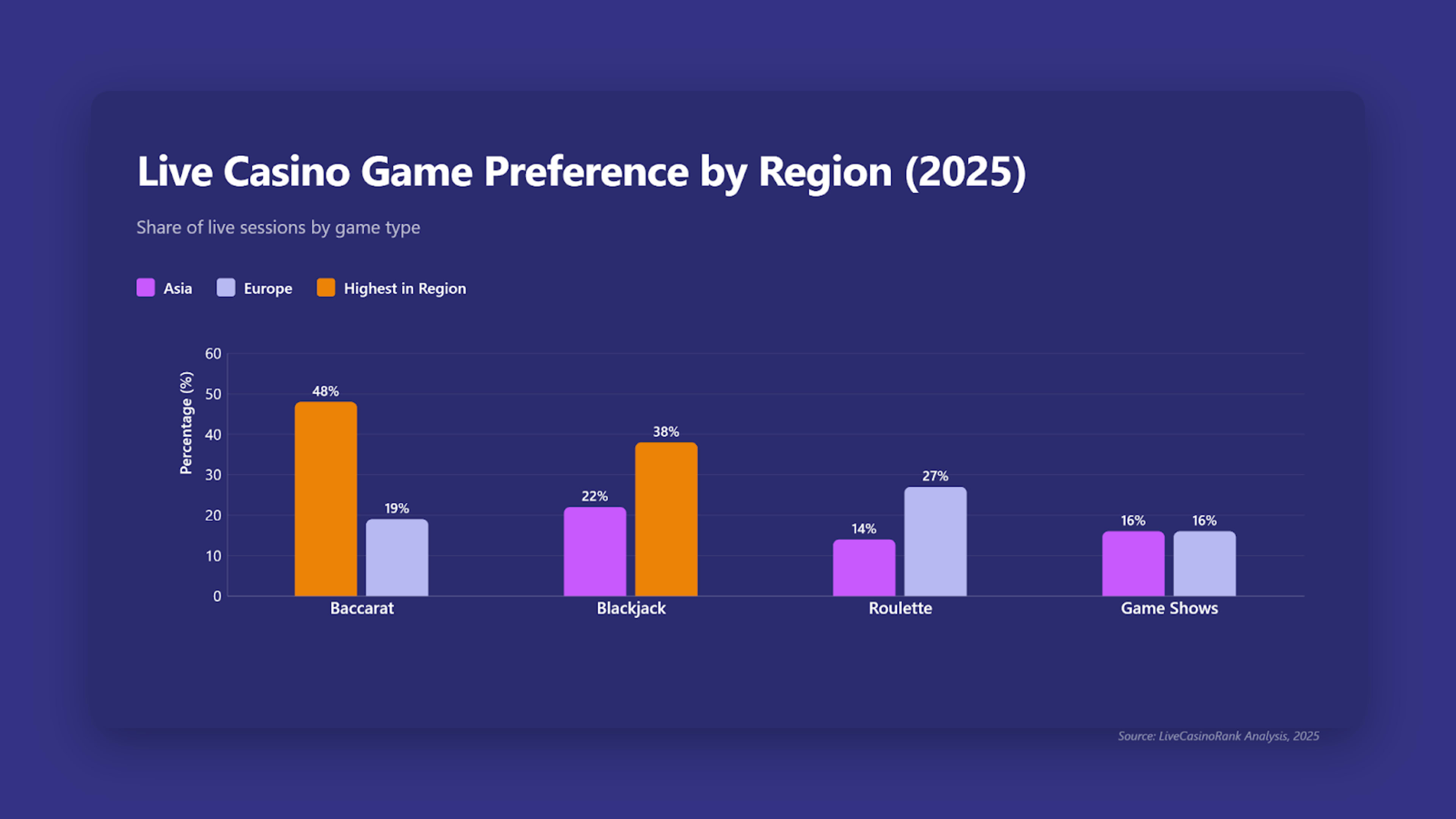
Live session distribution diverged sharply in 2025, with Asia leaning heavily toward baccarat while Europe maintained a stronger preference for blackjack and roulette.
Why Blackjack Held in Europe
Europe's live dealer growth in 2025 looked nothing like Asia's, and that was intentional.
In Denmark, Live Quickseat Blackjack led the rankings with 12 appearances across tracked periods. In Spain, Live Sportium Roulette ranked highest with strong rank efficiency metrics. Across Portugal, Italy, and Germany, operators built live lobbies around classic table formats with country-specific limits, native-language dealers, and branding designed to signal trust and regulatory compliance.
The variation is structural, not cosmetic. Europe is not a single market. It is a collection of distinct, regulated markets that happen to share a continent, and successful live dealer deployment requires acknowledging that fragmentation.
Blackjack has staying power in Europe for three reasons, and none of them are about nostalgia or tradition.
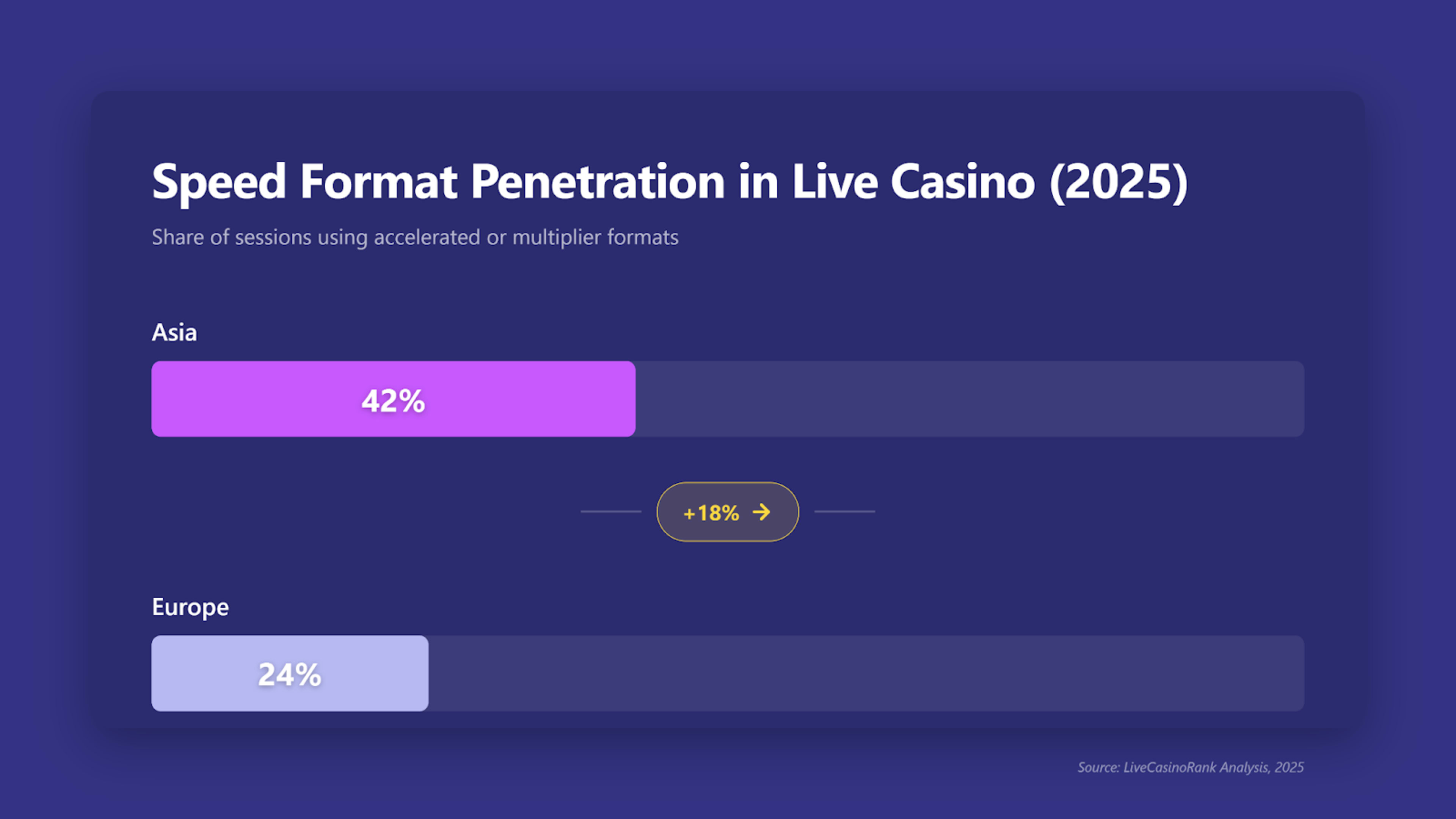
Speed and multiplier formats gained significantly more traction in Asia than in Europe, reflecting a stronger appetite for high-frequency live play.
The format is rules-stable across jurisdictions. Operators can localize presentation layers without redesigning core gameplay. That reduces compliance risk and speeds up market entry in fragmented regulatory environments. Localization occurs at the presentation layer, not the game layer, making it efficient to deploy across multiple markets simultaneously.
Blackjack functions as a trust anchor. Players recognize the format, understand the rules, and associate it with legitimate, licensed operators. In tightly regulated markets, familiar formats signal legitimacy and reduce perceived risk.
Supplier investment confirms demand is real. Playtech built a dedicated studio in Riga focused on classic blackjack and roulette tables. The Club Aurora facility includes multiple blackjack tables, roulette, and a branded trivia hub, all designed for European operator catalogs. Evolution continues expanding European studio capacity with formats tailored to localized operator needs. Capital does not flow to tradition. It flows to formats that drive retention and revenue, and blackjack continues to earn that investment.
Portugal is a good example. The market saw record turnover in 2025 with growing traction for live table games and live dealer options. Operators adapted through localized presentation and compliance-aligned branding. The game itself stayed recognizable. The presentation layer did all the heavy lifting.
What Studio Expansion Tells Us About Demand
Suppliers build multi-million-dollar facilities where the economics are already validated, and the infrastructure can scale profitably.
Evolution launched with live baccarat tables and targets PAGCOR-licensed operators serving Southeast Asia markets. That is a capacity expansion in a market already scaling at double-digit rates.
Launching with baccarat alone signals confidence in concentrated demand. If demand were uncertain or fragmented across multiple formats, the studio would have launched with a broader mix to test what worked. Instead, Evolution made a format-specific bet from day one because the data already showed where players were spending time.
In Eastern Europe, Evolution also opened a second studio in Romania in Q1 2025, expanding live table capacity in a core European production hub. Romania has become a reliable location for international operators, and the expansion reflects sustained European demand for localized live dealer content.
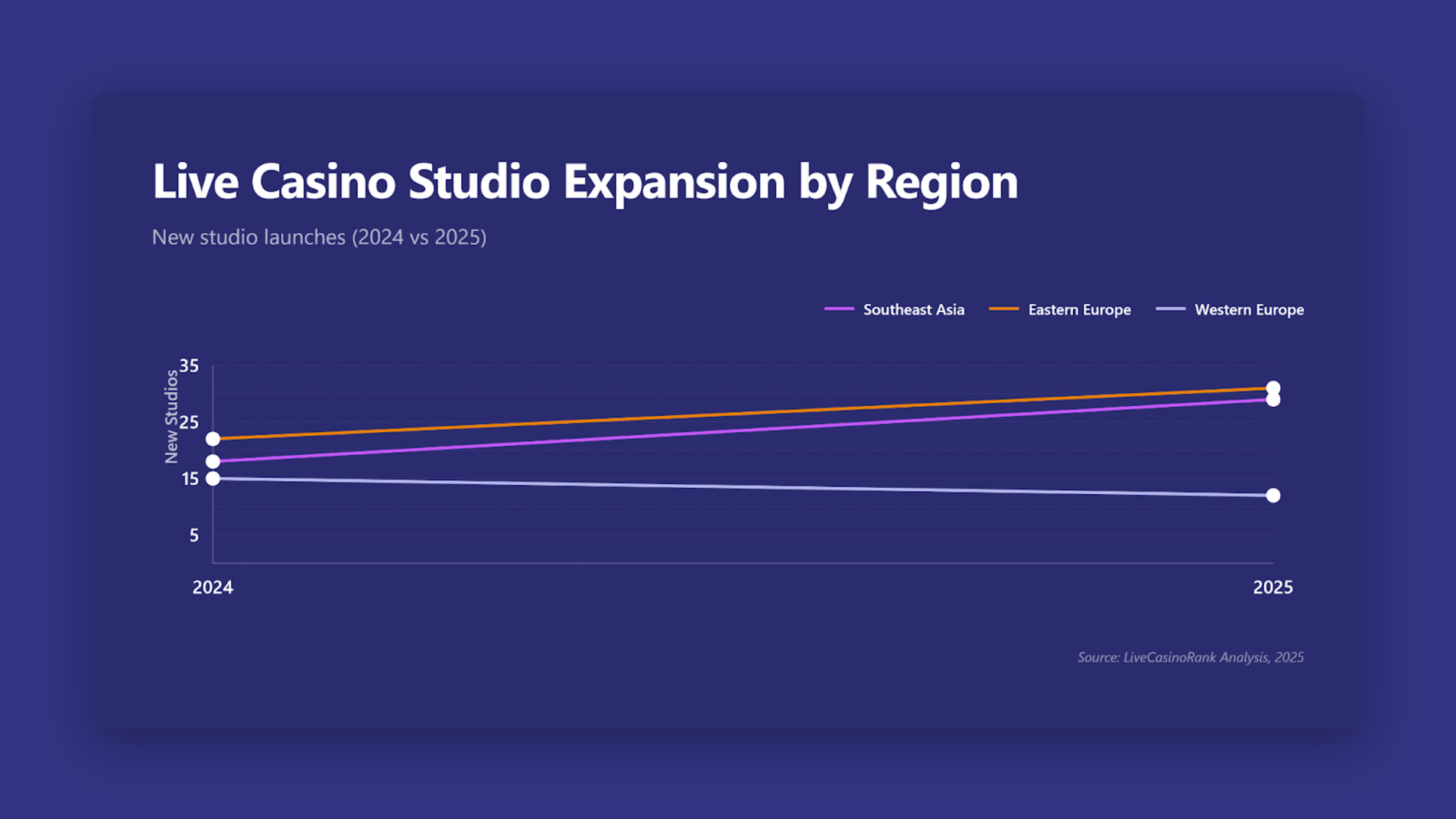
New live casino production facilities are increasingly concentrated in Southeast Asia and Eastern Europe in 2025, while Western Europe saw slower expansion.
Meanwhile, Playtech launched its dedicated Club Aurora studio in Riga with a format mix explicitly centered on classic blackjack and roulette tables. The facility serves European operators requiring branded, compliance-aligned content. The fact that Playtech committed capital to a classic-table-focused studio—rather than experimenting with newer formats—confirms that blackjack and roulette demand in Europe remains commercially strong.
Asia gets baccarat-first facilities designed for mobile-heavy, high-frequency sessions. Europe gets classic table studios designed for localized, compliance-driven operator catalogs.
Mobile Changed Everything, But Differently in Each Region
Evolution reported that 72% of operator revenue on its platform came from mobile devices in Q1 2025, up from 69% in the prior comparable period. Our estimate puts roughly 73% of live casino sessions globally on mobile devices as of late 2025.
That shift reshaped product design and lobby architecture.
But mobile did not produce uniform outcomes across regions. The platform is the same. The behavior is completely different.
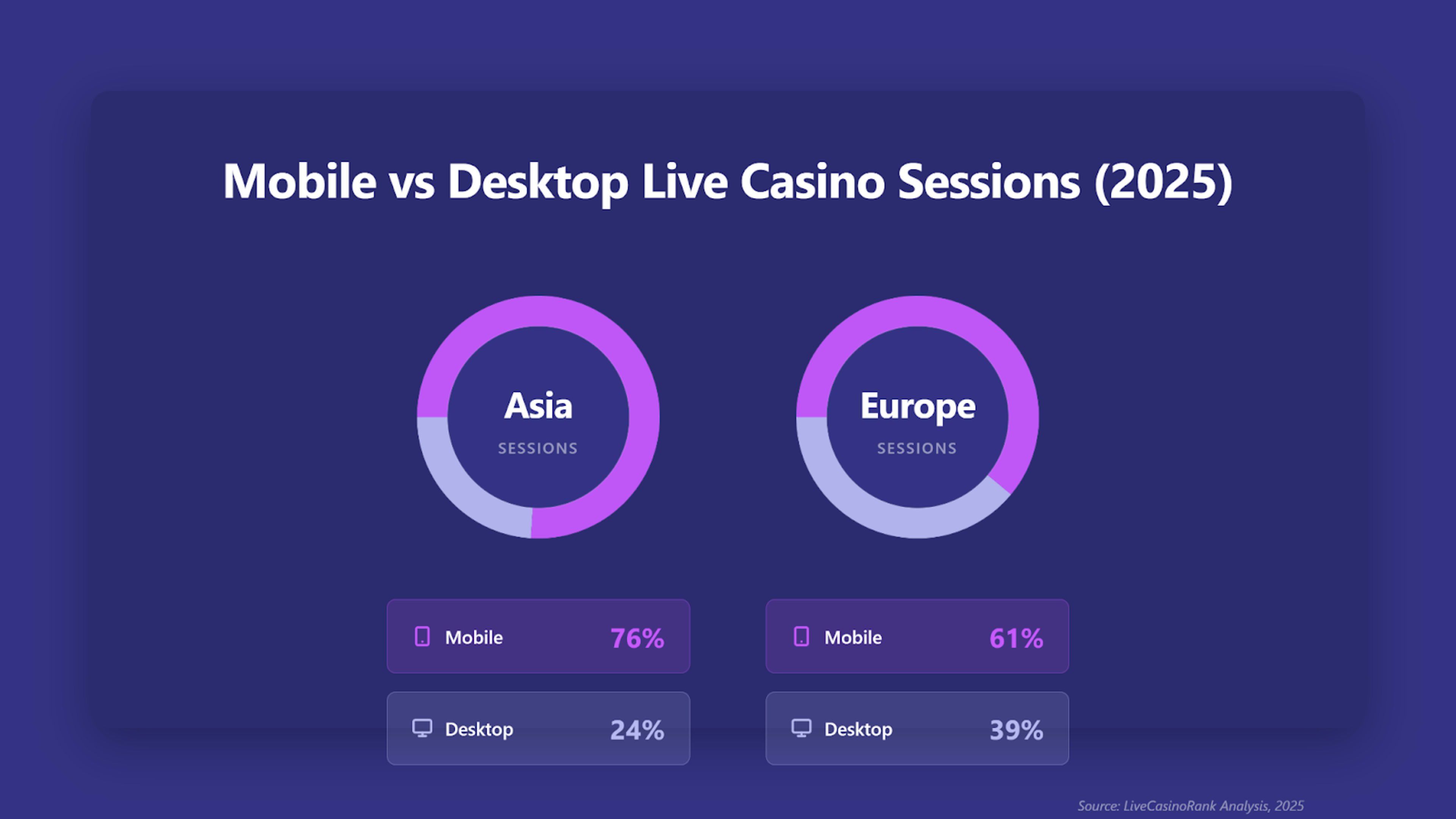
Asia showed a stronger mobile dominance in live casino sessions, reinforcing why studio production and localization are increasingly shifting east.
In the Asia-Pacific region, mobile adoption accelerated the shift toward baccarat hybrids. Everything is optimized for vertical displays, thumb-friendly controls, and instant access.
The result is two mobile-first markets that look completely different in terms of content mix, session behavior, and supplier strategy. Both are growing. Both are profitable. Neither is trying to converge with the other because the underlying player behaviors are structurally different.
What 2026 Will Likely Bring
The regional split is not closing. Supplier investment patterns suggest it will deepen through 2026 as both regions scale their respective models.
Asia-Pacific will see more baccarat-focused studio capacity as demand continues growing at double-digit rates. Suppliers that have already committed to the region will expand their facilities, and new entrants will likely follow the same baccarat-first playbook that Evolution validated with the Cebu launch. The format is proven, and player adoption is accelerating. There is no reason to hedge or diversify when one format is driving the majority of growth.
Europe will see deeper compliance complexity as more markets refine licensing requirements. Operators will need more country-specific content, not less. Suppliers will respond with dedicated studio capacity, branded table formats, and regional dealer pools that meet individual market standards. Blackjack and roulette will remain the anchor formats because they localize most effectively under regulatory pressure without requiring fundamental gameplay redesigns.
We will be tracking both regions closely through 2026 to see how these patterns hold as the market matures.