The Live Roulette Table Layout
The live roulette table has two betting areas displayed on your screen. The inside betting area contains individual numbers arranged in a grid of 12 rows and 3 columns, covering numbers 1 through 36 plus zero (and double zero on American tables). The outside betting area wraps around the grid and contains broader group bets: red/black, odd/even, high/low, dozens, and columns.
The live dealer and the physical roulette wheel appear at the top of the screen via HD or 4K video. The dealer spins the wheel, drops the ball, and announces the result. Your betting interface is digital: you select chip sizes, place them on the layout by tapping or clicking, and the dealer acknowledges your bets before each spin.
European tables use a single zero (37 pockets, 2.70% house edge). American tables add a double-zero pocket (38 pockets, 5.26% house edge). French tables use a single zero with la partage or en prison rules, reducing the house edge on even-money bets to 1.35% with la partage. Choose European or French whenever available, because the house edge is meaningfully lower. Read our comprehensive guide on the difference between American and European roulette to take a right decision on which variant suits you best.
How to Place a Bet in Live Roulette
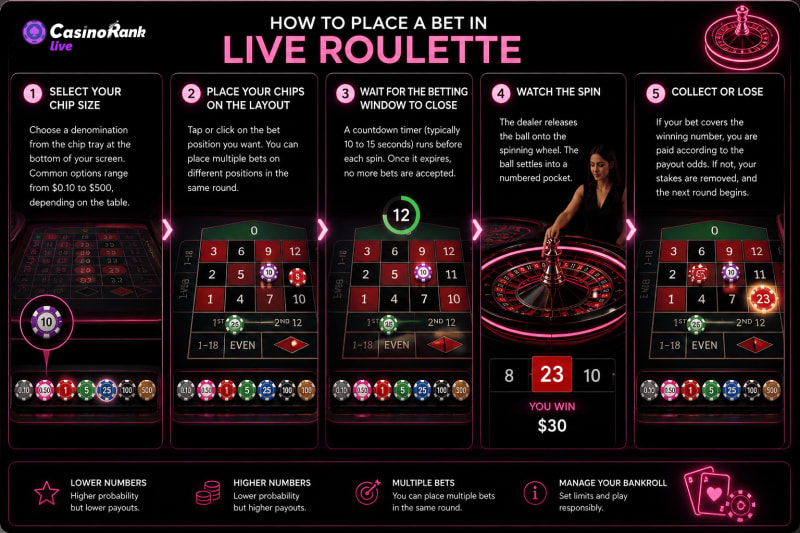
Placing a bet in live roulette follows a simple sequence that repeats every round.
- Select your chip size. Choose a denomination from the chip tray at the bottom of your screen. The available denominations depend on the table.
- Place your chips on the layout. Tap or click on the bet position you want. You can place multiple bets on different positions in the same round.
- Wait for the betting window to close. A countdown timer runs before each spin. Once it expires, no more bets are accepted.
- Watch the spin. The dealer releases the ball onto the spinning wheel. The ball settles into a numbered pocket.
- Collect or lose. If your bet covers the winning number, you are paid according to the payout odds. If not, your stakes are removed, and the next round begins.
You can place as many individual bets as you want within a single round, combining inside and outside bets freely. The minimum and maximum bet limits are displayed at each table and vary by operator.
Roulette Bets, Payouts, and House Edge
Every roulette bet has a defined payout, a probability of winning, and a house edge that varies by variant. The tables below cover all standard bet types for European (single-zero) roulette.
Inside Bets
Inside bets cover specific numbers or small groups of adjacent numbers on the layout. They offer higher payouts but lower probabilities of winning.
Bet type | Numbers covered | Payout | Win probability | House edge |
|---|---|---|---|---|
Straight Up | 1 number | 35:1 | 2.70% | 2.70% |
Split | 2 numbers | 17:1 | 5.41% | 2.70% |
Street | 3 numbers | 11:1 | 8.11% | 2.70% |
Corner | 4 numbers | 8:1 | 10.81% | 2.70% |
Line (Double Street) | 6 numbers | 5:1 | 16.22% | 2.70% |
Outside Bets
Outside bets cover large groups of numbers and offer lower payouts with higher probabilities of winning. These are the bets most commonly used by recreational players and most roulette strategies.
Bet type | Numbers covered | Payout | Win probability | House edge |
|---|---|---|---|---|
Red / Black | 18 numbers | 1:1 | 48.65% | 2.70% |
Odd / Even | 18 numbers | 1:1 | 48.65% | 2.70% |
High (19–36) / Low (1–18) | 18 numbers | 1:1 | 48.65% | 2.70% |
Dozens (1–12, 13–24, 25–36) | 12 numbers | 2:1 | 32.43% | 2.70% |
Columns | 12 numbers | 2:1 | 32.43% | 2.70% |
House Edge by Variant
The house edge stays constant across all bet types within the same variant, with one exception: French roulette's la partage and en prison rules only apply to even-money bets.
Variant | Zeroes | House edge (standard) | House edge (even-money with la partage) |
|---|---|---|---|
European | 1 | 2.70% | N/A |
French | 1 | 2.70% | 1.35% |
American | 2 | 5.26% | N/A |
The difference between 2.70% and 5.26% is substantial over time. On a $10 bet per spin over 100 spins, the expected loss at European roulette is $27. At American roulette, the expected loss is $52.60, nearly double, for the same payouts on every bet type.
Special Rules: La Partage, En Prison, and Surrender
Three special rules can reduce the house edge on even-money bets:
- La Partage (European/French tables). If the ball lands on zero, half of any even-money bet is returned to the player. Reduces house edge to 1.35%.
- En Prison (French tables). If the ball lands on zero, even-money bets are "imprisoned" for the next spin. If the bet wins on the next spin, the full stake is returned (but no winnings). Reduces the house edge on even-money bets to about 1.39%.
- Surrender (some American tables). Identical to la partage but applied to American double-zero tables. Reduces the house edge on even-money bets from 5.26% to 2.63%.
Neighbour Bets (French/European Tables)
Neighbour bets, also called announced bets or call bets, are predefined combinations that cover specific sections of the roulette wheel rather than the number grid. They are placed through a racetrack betting interface where a table offers one.
- Voisins du Zéro (Neighbours of Zero). Covers 17 numbers surrounding zero on the wheel: 22, 18, 29, 7, 28, 12, 35, 3, 26, 0, 32, 15, 19, 4, 21, 2, 25. Requires 9 chips across a combination of splits and corners. Win probability: 45.9%.
- Tiers du Cylindre (Third of the Wheel). Covers 12 numbers on the opposite side of the wheel from zero: 27, 13, 36, 11, 30, 8, 23, 10, 5, 24, 16, 33. Requires 6 split bets. Win probability: 32.4%.
- Orphelins (Orphans). Covers the 8 numbers not included in Voisins or Tiers: 1, 20, 14, 31, 9, 17, 34, 6. Requires 1 straight bet and 4 splits. Win probability: 21.6%.
- Jeu Zéro (Zero Game). Covers 7 numbers closest to zero: 12, 35, 3, 26, 0, 32, 15. Requires 4 chips (1 straight up on 26, 3 splits). A smaller, focused version of Voisins du Zéro.
Refer to our guide on the live roulette betting systems to get a better understanding of how to place bets to your advantage.
A Worked Example: 10 Spins at a Live Roulette Table
The session below illustrates how bets, results, and payouts work over 10 consecutive spins at a European roulette table with a $1 minimum bet. The player uses a $50 bankroll with $5 bets.
Spin | Bet placed | Stake | Winning number | Result | Payout | Bankroll |
|---|---|---|---|---|---|---|
1 | Red | $5 | 14 Red | Win | +$5 | $55 |
2 | Red | $5 | 0 Green | Loss | -$5 | $50 |
3 | Straight Up on 17 | $5 | 17 Black | Win | +$175 | $225 |
4 | Odd | $5 | 22 Black | Loss | -$5 | $220 |
5 | Dozen (1–12) | $5 | 8 Black | Win | +$10 | $230 |
6 | Red | $5 | 26 Black | Loss | -$5 | $225 |
7 | Split (19/20) | $5 | 20 Black | Win | +$85 | $310 |
8 | Even | $5 | 33 Black | Loss | -$5 | $305 |
9 | Column (3rd column) | $5 | 12 Red | Loss | -$5 | $300 |
10 | Red | $5 | 1 Red | Win | +$5 | $305 |
After 10 spins, the bankroll grew from $50 to $305. This is not a typical session; it is a worked example illustrating how different bet types yield different payouts. The straight-up win on spin 3 (35:1 payout) and the split win on spin 7 (17:1 payout) are responsible for most of the profit. Over hundreds of spins, results will converge toward the house edge, which is why bankroll management matters more than any single session result.
Live Roulette vs Land-Based Roulette
Live roulette and land-based roulette use identical rules, the same wheel, and the same payouts. The differences are in the experience, the pace, and the practical details of access. The table below summarises the key differences.
Feature | Live roulette (online) | Land-based roulette (casino floor) |
|---|---|---|
Dealer | Real person, streamed via HD/4K video | Real person, physically present |
Wheel | Physical wheel in a studio | Physical wheel on the casino floor |
Rules | Identical (European, American, or French) | Identical |
House edge | Same (2.70% European, 5.26% American) | Same |
Betting interface | Digital, on-screen chip placement | Physical chips placed by hand |
Betting window | Timed countdown | Dealer announces "no more bets" |
Minimum bets | From $0.10 (Auto Roulette) to $1+ | Set by the venue |
Pace | Set by the dealer (shorter at Speed tables) | Set by the dealer |
Social interaction | Chat with dealer and players via text | Face-to-face conversation |
Availability | 24/7 from any device | Casino operating hours, travel required |
Variants available | European, French, American, Lightning, Speed, Auto, Immersive, and more | Varies by venue |
The most significant practical difference is the minimum bet. Live roulette tables online start at $0.10 to $1 on our game pages, allowing players to learn the game at minimal cost. Land-based casinos set their own minimums per venue, so check the table sign. Players should start with lower stakes at a live casino to get a feel for the game's rhythm and the dealer's specific style without risking too much.
The second significant difference is variant availability. Live casino lobbies offer a wide range of roulette variants online. Multiplier variants like Lightning Roulette and PowerUP Roulette, cinematic formats like Immersive Roulette, and automated options like Auto Roulette are all available online.
The third difference is the betting interface. At a land-based casino, you place physical chips on the felt, and the dealer manages the table manually. In live roulette, the interface is digital: you tap or click to place bets, the system calculates payouts automatically, and your bankroll updates instantly. This removes the risk of placing chips in the wrong position and speeds up the payout process.
One area where land-based casinos retain an advantage is atmosphere. The ambient noise, the presence of other players around the table, and the physical ritual of handling chips create an experience that even the best HD stream cannot fully replicate. Some live roulette formats, particularly Immersive Roulette with its multi-camera slow-motion replays and Live French Roulette with its classic presentation, come closer than others.
There are also differences between live online and RNG online formats, which are explained in more detail in our dedicated RNG vs. live online roulette guide.